Happy Halloween to all out there. Pictured above is an old Bev-Bel Halloween car from 1978. For those who don’t know or don’t remember, Bev-Bel was a company that bought undecorated Athearn train cars and painted them for smaller rail lines or regional lines not produced by the major manufacturers ( Athearn, Roundhouse, etc.) They also made specialty cars like the one above to celebrate the different seasons.
I apologize for the lack of posts this month. October Tends to be a busy month work wise, with a heavy travel schedule. Add to that trying to get everything done around the house that needs to be taken care of before the snow flies and the thought of getting anything done downstairs seems like wishful thinking.
But the good news is that I have been able to make progress on the layout. I managed to squeeze in a little here and there, and before you know it the benchwork is nearing completion. It seems like when you don’t have big blocks of time to finish something, you kind of write off the little bits of found time as not enough to get anything done.
I know this will be different as I get into later stages of layout construction, such as track work or scenery construction, where you can accomplish a lot in small blocks of time. But I put aside the natural inclination to say “oh well, maybe tomorrow” and do what I could with what time I had. And it’s truly amazing what you can get done when you do that.
First off, finished the last set of major cabinets on the other side of the peninsula. There will be a couple of small cabinets that go on the turn back portion of the peninsula. Now I know there are some out there who are throwing the arms up and saying “what is it with you and cabinets”. Let me explain. There are a lot of modelers out there who build their layouts and use the underside for storage. I don’t want to offend anyone, but I’ve done this and I have found that the stuff under the layout tends to pile up and slowly creeps out from underneath.
And even though my loving wife totally supports my hobby and consented to the whole basement as a layout room, still thinks of it as the basement and thus a place where things go that she doesn’t want upstairs. So storage was important.
Anyway, cabinets are done.
Last set of main cabinets installed.
Second, finished the lower level benchwork over the new cabinets.
Lower deck benchwork in place on cabinets.
And last but not least, I was able to temporarily install the upper level of benchwork along the entire peninsula. The reason I did it this way was so that I could get all the pieces cut to size and all wire run holes drilled. For the most part the pieces are a solid stringer that extends all the way across. But there was some fitting of pieces around the support posts and the pieces that make up the outside corner. Now that I have them all cut and drilled I will take them out, paint them and reinstall them. I can then install the rim joist.
Upper lever benchwork installed on peninsula.Upper level benchwork in back aisle. The “hole” is still open for the helix.Alternate view of upper level benchwork on peninsula.Upper level benchwork on other aisle.
Side note: I was sure once the other cabinets were installed on the other side of the peninsula that the stability of the center support “wall” would be fairly solid. I was surprised, happily so, that it is rock solid. I felt so confident in its strength that I played around with the idea of having my wife take a picture of me laying across the upper benchwork stringers. Common sense got the better of me and I decided not to press my luck.
Lastly, I’m posting a couple of pictures of display cabinets. The first two are ones that my father had made for me after I got back into the hobby after I was married. He tried to match the original. The doors were made of 1/4″ plywood and warped badly. I replaced them with clear plexiglass .
The other two cases built by my father for me.
All but about 6 of the engines are old Athearn Blue Box or Bachmann DC engines.
The other case was the original one that my father made for me about 45 years ago. At one time it held all of my engines and train cars, but that was along time ago. I’m repairing some damage on the doors and will paint them to match the cabinets.
Original train case built into base cabinets.
Next up: either the end of the peninsula or the base for the helix.
As I was reading through my last post after publishing it, I realized that some may get the impression that I was going to run the railroad with about 70 railcars and a whole lot of engines. And cabooses.
The home road lettered cars that I talked about, the coal hoppers and boxcars, would be in addition to the other cars that I have lettered for other railroads. These would be the other railroads that operate in the upper Midwest and northwest that would interchange with the Continental Northern. Examples would be the Northern Pacific, the Great Northern, the Union Pacific, Soo line … you get the idea.
The number of home road cars that will eventually be on the layout has yet to be determined. Right now I have 30 hoppers lettered for the CN, but I know that I will need another 15 for basic operation. The 20 boxcars that I had mentioned is just a start. I have to get every thing out on the layout to see what I have. From there I will make sure the percentage of home road cars to “foreign” cars is right.
For those who don’t know, when a shipper sends something in a boxcar, for example, and the car is interchanged onto another railroad, the receiving railroad has to pay the home road for the time that the boxcar is on their line. The receiving railroad would then make sure that the car got to its destination as quickly as possible, was unloaded and sent on its merry way. Either back to its home road or loaded with something new and shipped of to a destination on some other railroad. That is why the greatest percentage of a type of car will always belong to the home road on a layout. And that is why I have to see what I have and then adjust so that I have the appearance of a reasonable percentage of cars.
There are those out there with enough experience that probably understood this from the beginning, but it was bugging me and I felt that a clarification was in order. OK, clarified. I hope.
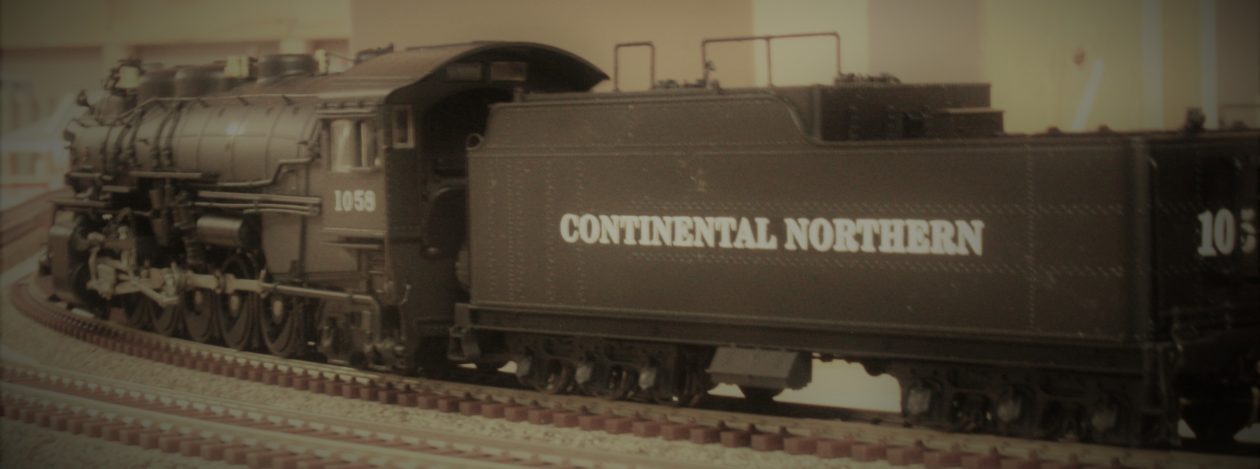
Below are a couple of pictures: the first is of a 2-8-2 Mikado with a string of hoppers.( sorry about the fuzziness, still working on depth of field) The second is of a pair of SD-7’s, one lettered for the CN and the other for the old road.
I have tried to keep the Locomotive and rolling stock roster for the Continental Northern as appropriate as possible. When dealing with a freelance railroad the trend is sometimes “anything goes”. The bulk of the motive power is 2-8-0’s and 2-8-2 Mikado’s. These wheel arrangements would handle the Midwest flatlands relatively well. The lighter engines are supplemented with 4-8-4 Northerns and 4-8-2 Mountains, as they had to handle the mountainous regions out west. Add in several compounds because: A. other roads used them to get through the Cascades in the Pacific Northwest and B: they are really cool. There are also several GP and SD-7’s as dieselization shows up even on this subdivision.
The thought process is as follows: as the Continental Northern dieselizes, the newer power ( diesels ) are used out west where the lack of needed maintenance and frequent refueling ( water and coal ) are better suited to diesels. The older steam engines are moved to the eastern divisions, where there are shorter runs between towns and maintenance facilities.
ROLLING STOCK
The main reason I backdated the layout to 1954 was that inexpensive, high quality steam locomotives became available. Bachmann (bachmanntrains.com) and Athearn (athearn.com) led the way followed by Broadway Limited (broadway-limited.com) with their DCC/ sound equipped locomotives. The hardest thing to give up was the diverse rolling stock of the more modern era’s. It seems as if each commodity has it’s own type of railcar. When I first switched I figured there would be a whole lot of boxcars and not much else. At least I would be able to cabooses on the trains, oh well.
Once I started to research the era more I realized that, yes there would be a whole lot of boxcars, there were a lot more types of cars in use. So yes, there will be boxcars, as well as hoppers for hauling coal, flatcars, tank cars, gondolas and short covered hoppers, which were starting to show up for some commodities. And cabooses.
I have the bulk of the hoppers for coal, I bought data only hoppers from Walthers (walthers.com). I still need to get another set. These are lettered for the Continental Northern. I have looking at picking up about twenty data only boxcars from Accurail (accurail.com), however they have been out of stock. I hope they will do another run soon. These will also be lettered for the Continental Northern. I have been lettering the cars with custom decals from Rail Graphics (railgraphicsdecals.com), I would highly recommend them.
PASSENGER CARS
There won’t be any “name” trains running on the railroad, as the run from the Twin Cities to Duluth is only about 120 miles. There will be daily passenger runs, but the trains will be mainly coaches. These will be mostly older, heavyweight cars.